Walk with us as we strive to build classrooms where every child’s aspirations have room to take shape — and the chance to take flight.



The Role of Better Infrastructure in Building Opportunity
Across India each morning, children step into classrooms hoping for a day that brings them closer to the future they imagine for themselves. Their curiosity, enthusiasm, and determination are unmistakable. Yet the buildings they enter — the physical spaces meant to nurture that learning — are not always equipped to support the dreams they carry.
The promise of education begins with the environment in which it unfolds. Classrooms, libraries, playgrounds, laboratories, sanitation facilities, and access to technology all play a silent but decisive role in shaping a child’s confidence, comfort, and ability to learn. When these foundational elements are strong, the classroom becomes more than a room. It becomes an invitation — a space that inspires children to believe that learning is for them, that their presence matters, and that their futures are worthy of investment.
In developing countries like India, however, the difference between educational environments can be striking. The infrastructure divide between government and private schools has created two very different experiences of learning — not divided by talent or aspiration, but by the physical spaces children walk into each day.
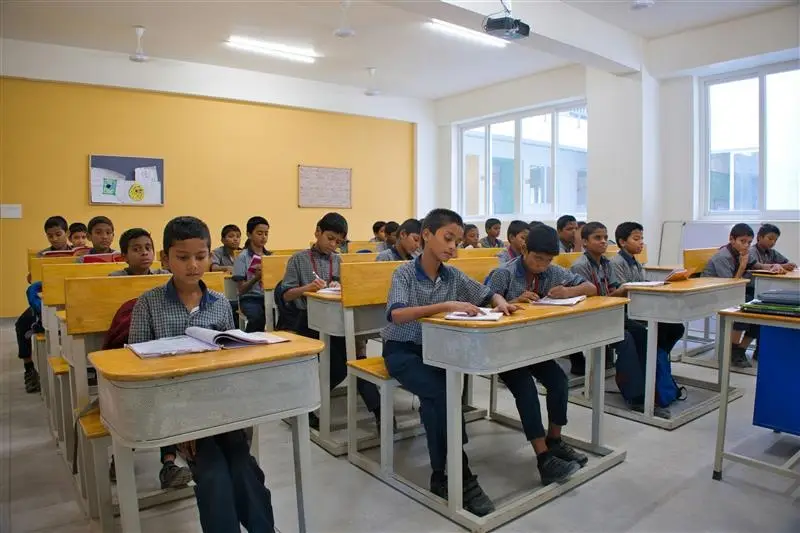
India has made immense strides in ensuring that children attend school. Enrolment is high, and classrooms are full. But not all classrooms offer the same opportunity.
In many private schools, children have access to libraries that encourage exploration, computer labs that nurture digital confidence, and safe, well-maintained classrooms that make learning comfortable. By contrast, many government schools — especially in rural communities — struggle with uneven resources and environments that limit the potential of otherwise bright, motivated learners.
Research from Karnataka in 2020 illustrates the gap clearly: while most private unaided schools had computer labs and internet access, only about 34% of government schools were equipped with functional computer labs.
National reporting paints a similar picture: just 58.6% of government schools have internet connectivity compared to 77.1% of private schools, reinforcing a deep digital divide that significantly shapes children’s learning experiences.
Infrastructure rarely enters public conversation with the urgency it deserves. Yet those who have observed classrooms closely know how deeply physical environments influence learning behavior, emotional safety, and classroom culture.
Studies consistently show that learning outcomes rise when infrastructure improves. Children attend more regularly, participate more confidently, and perform better academically. The environment does not just influence what a child learns; it shapes how they feel about learning.
The good news — and it is a powerful one — is that infrastructure gaps can be bridged. They can be addressed through thoughtful, targeted investment and sustained support.
A library becomes a gateway to imagination, where reading feels expansive rather than instructional. A computer lab opens pathways to digital literacy, allowing children to engage with tools that once felt unreachable.
Safe sanitation gives students — especially adolescent girls — confidence to attend school without hesitation.
Comfortable, ventilated classrooms help children settle in, focus longer, and engage more fully. Playgrounds encourage collaboration, resilience, and emotional growth through play.
In this sense, upgraded infrastructure does more than improve the way a school looks. It has a direct influence on the emotional climate of the classroom, creating conditions in which both students and teachers can engage with learning in a more sustained and confident way.
Support A Dream works with a simple belief: every child deserves to learn in an environment that strengthens their potential, not one that dims it.
By supporting agencies and grassroots organizations working to improve school infrastructure, Support A Dream contributes to initiatives that:
As these efforts take root across different communities, what emerges is a shared understanding that environments shape learning just as deeply as lessons do. Children respond not only to what they are taught, but to the spaces in which teaching happens — to rooms that feel safe, to corners that spark curiosity, and to facilities that respect their dignity.
Walk with us as we strive to build classrooms where every child’s aspirations have room to take shape — and the chance to take flight.
Your support helps build futures rooted in dignity, care, and opportunity for every learner.
Why ages 13–21 are the most fragile and most powerful phase in a student's life.
Read more
Our newsletter — stories, progress, and what we're learning.